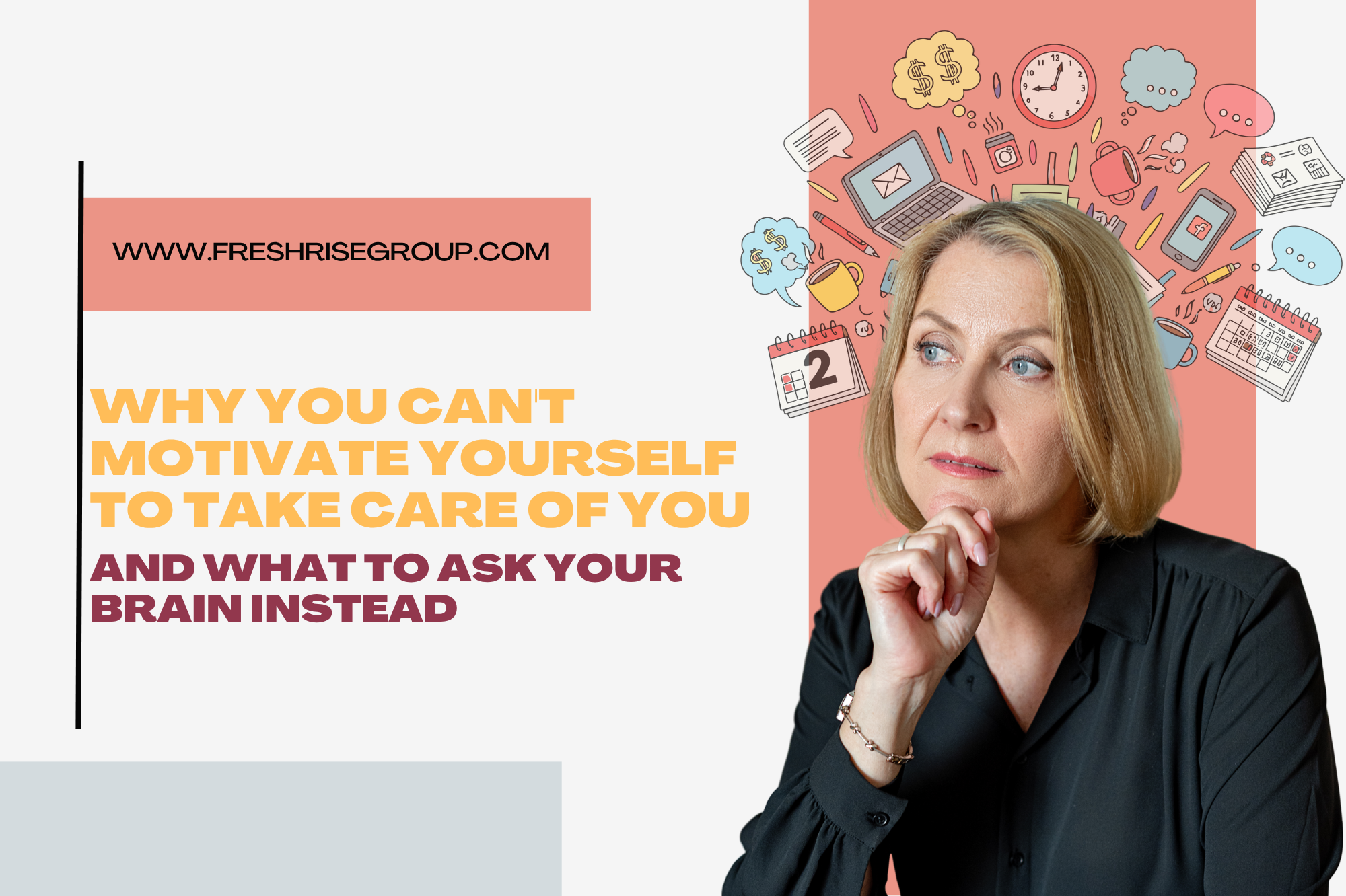
Why You Can’t Motivate Yourself to Take Care of You (And What to Ask Your Brain Instead)
My back has hurt like crazy for the last eight days.
Here’s the weirdest part. All of a sudden, Sarah is very interested in taking care of Sarah.
I’m stretching. I’m pulling out every PT practice I can remember. I went to the doctor, I’m taking my medication, and I’m paying attention to how I sit and move. I’m bending my knees to lift instead of bending at the waist.
All the things I know I’m supposed to do for my own health, and suddenly I can think about them, find time for them, and actually do them.
Which made me wonder. Why can I not find this motivation when nothing hurts?
Why knowing it’s good for you is not enough
I know I should walk every day. I know I should stretch. I know I should sleep more. You probably know your list too.
We already know the shoulds. And yet they don’t move us. What moves us is what we feel responsible for. What we are protecting others from. What expectations feel strongest.
In all of my hours of pacing and resting this week, two things are becoming obvious to me and it sounds familiar to what I hear from other women in this mid-career space.
First, “good for me” is sometimes just not a good enough reason. If you have an interest-based brain, maybe due to ADHD or other neurodiversity, or you’re in perimenopause and dealing with some of the same symptoms, you may already know this but if you are anything like me, I didn’t. When we’re not interested in doing something, even if it’s good for us, it doesn’t happen. That is not how our brain gets motivated.
Second, every new “should” lands on top of the 47,000 things we’re already supposed to be doing. So it doesn’t feel like care. It feels like one more thing.
My back, on the other hand, has my brain’s full attention. There’s urgency. There’s immediate feedback about what helps and what doesn’t. There’s a crystal clear goal: make this stop hurting.
That is way more compelling than “Sarah, walking and strength training are good for you.” My brain hears that and it just stops listening completely!
I’m Going To Ask Better Questions.
Instead of “Why can’t I make myself do this?”, I’m going to use this:
What DOES my brain care about most right now, in this season of life, and how can I use that here?
For me, when I think about it, a strong back isn’t really about my back or avoiding pain. It’s about being able to say yes when my 11-year-old wants to play volleyball in the yard. There are fewer and fewer of those invitations at this tween stage, and I want to be able to say yes. It’s about playing pickleball when my sister asks who’s in. It’s about being able to babysit and love on my baby nieces and nephews
Stretching because it’s “good for me” is meh. Stretching so I can play with my kid hits completely differently. It’s a focus on a purpose that matters a lot to me.
Here’s how this might look for you:
- Instead of “I should strengthen my core,” it might be I want to be able to get down on the floor to play with my grandchild and make some memories – what would help me be able to do that better?
- Instead of “I should do more cardio,” it might be planning the hiking trip with your friends in a couple of months and planning mini-hikes before then.
- Instead of “I should walk for my health,” it might be your workday has gotten boring and you want something fun to add to the days – a walk to the water or the park
Same behavior. Completely different engine behind it.
For me, that engine is fun, connection, new spaces, and playing. What is it for you? Taking a moment to figure that out is a critical piece.
Stress is vague until your body makes it specific
There’s a second layer here, and it’s one of the most useful things this week taught me.
When my low back hurt, I knew exactly where to look. There it was. It was obvious, and I could focus on solutions for that one problem.
Mid-career stress rarely introduces itself that nicely. It’s more like a big cloud. That meeting was a lot. The days are back to back. The calendar is packed. At 3 a.m. you’re replaying a presentation you were already well prepared for, with ten versions of the future running in your head.
When stress is a giant cloud, it’s too big to attack. We end up thinking everything is awful, work is the worst, and the only answer is some big, dramatic change like quitting. The more useful move is to pull it apart and ask what is actually not working.
Your body can give you clues. Your emotions can give you clues. Your inner wise voice can give you clues.
- Is tension showing up in the same place again and again?
- Are you getting regular pain in a certain area?
- Are you lying awake thinking about the same kinds of things?
Not every ache is stress, and please see your doctor when something hurts. I did. But notice where it hurts when you know you’re stressed. You might be surprised by the connections.
One question to sit with
Here’s what I’m leaving you with this week.
So many of us are holding all the pieces right now. Careers, income, kids, health, everyone’s schedule and even global disruption. Our brains burn a lot of energy keeping it all, mulling it over, and stress eventually finds a weak link, whether that’s your back or somewhere else.
So take a moment and ask yourself: What are my biggest stressors and how does it show up for me?
And then ask the companion question: What DOES my brain actually care about right now that can help me get motivated to take action against the stress?
If you want help seeing how much you’re carrying behind the scenes, start with the Mental Load Quiz. It takes a few minutes and helps you see where the weight is coming from.
Sarah Rose is a workplace well-being coach, recovering over-worker, married mother of 2, and founder of Fresh Rise Group. She helps maxed-out mid-career women who are juggling approximately 47 roles (but only getting paid for one or two) reclaim their energy, boundaries, and confidence without quitting their entire lives. A former “good girl” turned possibility pusher, Sarah challenges long-held beliefs about productivity and being good, but also teaches quick, doable strategies that work even on days when your brain feels like mush.