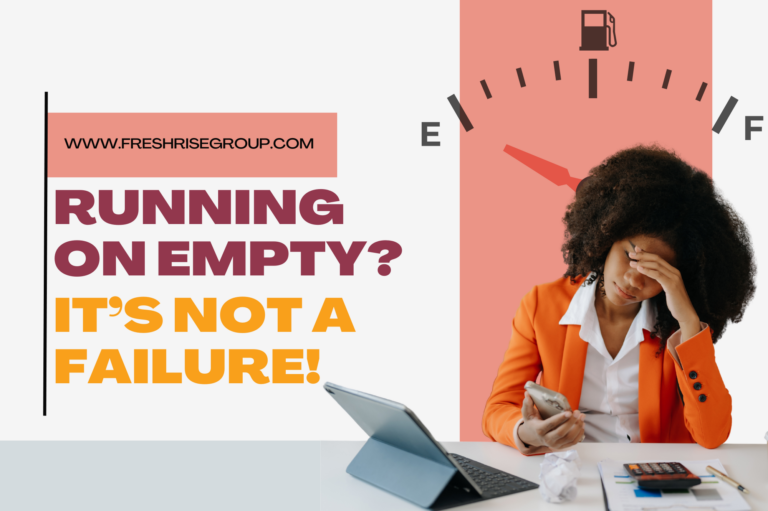

Why Working Women Are Burning Out Faster Than Ever And Why You Should Pay Attention.
Working women are burning out under the weight of career demands, parenting, mental load, perimenopause symptoms, caregiving, and relationship pressures.
If you’re a working woman in your 30s, 40s, or 50s, chances are you’re carrying more roles than any generation before you, and somehow you are expected to perform them all at a high level, gracefully, without dropping anything important.
No wonder women tell me things like:
“I’m tired down to my bones.”
“I feel like I’m failing everywhere.”
“My brain used to be sharp… now it feels like fog.”
“I’m the default parent, the default problem-solver, the default everything.”
“I can’t keep going like this.”
There is so much frustration, hurt, and overwhelm bottled up in our working women right now but there is almost no safe support in our workplaces to get help. Even if a women happens to be one the few with a caring and emotionally intelligent boss, they can only listen for so long before they are getting pressure for you to perform.
Overwhelm starts to bubble up like hot tomato soup on a stove. It bubbles up in outbursts in meetings, in emphatic statements about what’s not working, in frustration directed at your boss or at you, in having to take more days off, in our bodies in the form of health issues, and in the relationships that really matter to us. One thing is for sure, the bubbling is going to cause more issues if we can’t turn down the heat immediately.
The Real Reason Working Women Are Running on Empty
Think about it – women in 2026 are juggling more:
– Full-time careers
– Household management
– Emotional and cognitive labor at work and home
– Kids’ mental health
– Kid’s sports, activity, and playdate schedules
– Aging parents
– Perimenopause symptoms
– Workplace bureaucracy and internal barriers to progress
– Organizational change and layoffs
– Supporting teams at work
– Trying to maintain friendships and relationships
– Social media distractions, constant interruptions
– Kid’s safety and phone use
Women are basically running 15 lanes of responsibility at the same time and the funniest (not so funny) part is that most women think they are failing. Mic drop.
So, they focus on what has worked in early career:
– Work harder
– Push through
– Just get more done in a day
– Wake up earlier – Work later into the evening
– Hold on tight until life “slows down”
But life isn’t going to be slowing down.
Your workplace isn’t redesigning itself to reduce pressure – yeah, I really hoped to make that happen, too, but it will not.
Trust me, trying to make change from the middle of a big organization really is not realistic or feasible. Maybe it’s even equivalent to banging one’s head against the wall.
So, the reality is that we can’t wait for some magical moment where the stars align, where hope and “opalite” lights up the sky – instead we have to take charge now to choose what we can control so that we don’t keep sinking.
Burnout Shows Up In Our Body and Mind
It starts with small symptoms that seem unrelated:
- Brain fog
- Irritability
- Forgetfulness
- Emotional dysregulation
- Exhaustion that sleep doesn’t remove
- Feeling disconnected from work
- Struggling to concentrate
- Not caring about the work
These are stress signals.
But women are busy pulling off magic tricks in the rest of their life so they rarely notice those and definitely don’t give attention to their own health care needs!
The Hidden Factors:
1. The Mental Load Nobody Sees (Not Even Women Themselves)
Women carry the invisible responsibilities that keep households, schedules and relationships functioning. Most of my clients report about 80% of the heaviness in life is caused by the need to anticipate, plan, remember for an entire family or office, and craft communication effectively. This mental load alone is a full-time job that we aren’t taking into account yet.
2. Workplace Expectations That Ignore Reality
Most workplaces still aren’t designing jobs, spaces, practices or policies for working women. Despite the majority of employees (men and women) have parenting responsibilities that will always take precedence over work because, well, keeping our loved humans safe matters a lot – even more than a pay check. However, there are very few organizations that design to make work easier on working parents. In In addition, work in the US currently has a very masculine style to it – we are expected to push harder, focus on outcomes over relationships, a value on forced forward movement, and visible productivity, ROI, and outcomes. Women however are doing a lot of the ‘gluing’ and invisible work of organizations. They are ensuring people are kept in loops, they are coregulating coworkers emotions, they are looking underneath the situation a bit longer, and they are focused on relationships and acting in integrity even in times of cuts. This isn’t to say men aren’t but as a way of being, women tend to show up with the skills to view the situation more holistically.
3. Perimenopause: The Reality That Can’t Be Named
Women in their late 30s–50s experience a surge in cognitive and emotional symptoms that may speed up burnout, present as ADHD-like symptoms or depression but are caused by normal reproductive hormones changing and interacting and sometimes wrecking havoc on brains, concentration, and emotional regulation. Of course, none of this can be openly discussed because it’s seen as a female problem, in 2025 it was labeled as inappropriate DEI work, or in most places nuisance that doesn’t get any attention.
4. Continual Lane Widening At Work
In mid-career, women have accumulated so much experience, expertise, work relationships, and partners that are more or less supportive depending on the situation. They are now mentoring, leading, onboarding, mediating conflicts, running projects, informally solving internal and external problems – often with no extra time, support, or recognition.
5. Emotional and Mental Load Has Expanded in Mid-Career
Women often feel responsible for keeping the emotional temperature of the home stable and of buffering big responses that create insecurity, fear, or confusion for their kids. This doesn’t even begin to touch the effort it takes to maintain connection and personal friendships that could refuel women but don’t seem to fit in to busy lives.
Women are NOT Failing.
They are trying to be good at impossible levels of invisible and visible work.
It’s a set up, friends.
The sooner we can see it, the more we can separate it from ourselves and stop believing that this was a reasonable expectation in the first place.
It seems obvious that awareness is the first step, but most of us are just too busy, too stuck in our spinning thoughts to see what is really happening.
Sarah Rose is a workplace well-being coach, recovering over-worker, married mother of 2, and founder of Fresh Rise Group. She helps maxed-out mid-career women who are juggling approximately 47 roles (but only getting paid for one or two) reclaim their energy, boundaries, and confidence without quitting their entire lives. A former “good girl” turned possibility pusher, Sarah challenges long-held beliefs about productivity and being good, but also teaches quick, doable strategies that work even on days when your brain feels like mush.