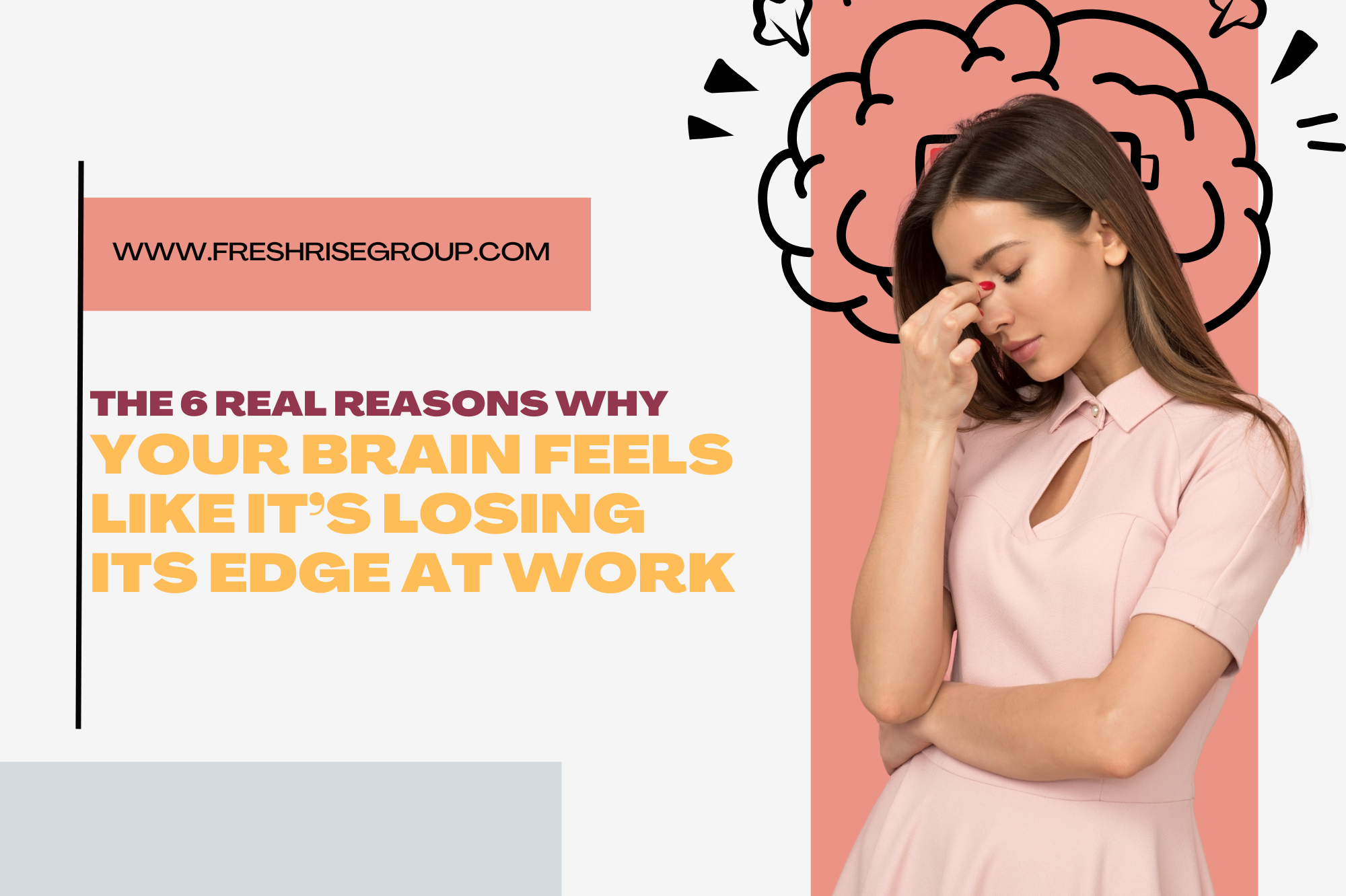
The 6 Real Reasons Your Brain Feels Like It’s Losing Its Edge at Work
There is something that we aren’t talking about that is adding work friction to the middle of our careers.
My personal experience and those of my clients keep pointing to the “sneaky 6” – Six key shifts that happen in mid-career that seem to be shutting down our brain’s focus and also our wellbeing.
These seem especially true for women, but many of these are true for my other clients as well.
In mid-career, the load you hold has shifted. Your brain is carrying an unprecedented amount of reminders, details, expertise, and health changes during this season of life. While these often feel like things you cannot control, there are real solutions to help you get your edge back! But before we look at solutions, we must look at the causes clearly and distinctly so you can stop self-judging and more clearly see what is actually happening.
Here are the 6 real reasons why your brain feels like it’s losing its edge at work:
- You Stayed Too Long in a Role That Stopped Fitting
It is deeply confusing when a job looks fantastic on paper, offering good income, stability, progression, even prestige, and yet it leaves you feeling completely drained internally. You stay because it seems like the logical choice; you are now an expert, and on some levels, it’s easy to stay, and let’s not talk about how everyone around you asks why you would ever want to leave.
However, your brain and body register the mismatch long before you do consciously. Spending months or years navigating the same circular conversations, corporate politics, and pretzel logic decisions that you have to explain to your team – it all can wear heavily on your spirit. Eventually, your brain simply says, “I am over this,” and shuts down its desire to spend energy on it because the environment is no longer serving your growth, interest, or alignment.
- Your Nervous System Has Been Marinating in Cortisol
We rarely realize the profound mental toll of chronic, daily workplace stress. Every single email ding, Slack notification, and urgent message triggers a micro-dose of cortisol. When we are asked to live a mid-career life of rushing from one back-to-back meeting to another, barely having time to drink water or even run to the bathroom, your nervous system is trapped in a perpetual high-alert state.
To your brain, this constant pressure feels exactly like being chased by a lion. Research shows that staying in this state inevitably deteriorates your health, severely impacting your working memory, patience, motivation, and emotional regulation. Your brain isn’t broken; it is simply exhausted from running from an imaginary predator. It needs you to pay attention.
- Perimenopause Turned Your Brain Secretly Into an Interest-Based Brain
We are taught almost nothing about perimenopause, and it can start wreaking havoc in your late 30s or early 40s without any obvious physical indicators. In my experience, it doesn’t actually start with hot flashes; instead, it hits your cognitive functioning first. While the research on Perimenopause and Interest-Based brains is still limited, I will tell you that every single day, I hear the common experiences for those of my clients with ADHD and those heading into Perimenopause.
We do know that hormonal fluctuations can drop your dopamine levels, increase cortisol, and impact cognition. If my hunch is right, the estrogen drop also means your brain can no longer force itself to focus on the most important things unless it has interest, novelty, challenge, urgency, or purpose. From personal experience, this feels like brain fog, forgetfulness, overstimulation, and intense irritability. Because you are used to relying on your memory to operate efficiently, this sudden drop in working capacity makes you feel like a fraud or a failure at your job. I believe that this is the impact of a profound biological shift that no one is preparing women for.
- Your Lanes of Responsibility Have Gotten Way Wider Than 10 Years Ago
Think back to where you were 10 years ago, when you were 25 or 30. Your life was likely much more streamlined and had a much smaller scope. Today, your lanes of responsibility have not only grown more complex; they have expanded massively.
You are no longer just managing your career. You are likely navigating widening lanes around parenting, partnership, running a household, pet care, volunteer commitments, financial planning, and managing your own health. You aren’t just doing your job anymore; you are holding everyone else’s moving parts in your head so that the balls don’t drop and create an emotional weight for you. This massive mental load expansion leaves very little cognitive bandwidth left for slowing down to actually think and focus about just work.
- Your Brain Can No Longer See the Purpose of ‘Pushing’ Constantly
High-capacity women are notoriously good at white-knuckling their way through stress. You are used to being the person who can hold it all together and push past the exhaustion to meet a deadline.
But your brain in mid-career seems to reach tipping points where it refuses to keep pretending everything is fine. When you are trying to juggle a hundred balls at once and you only have the actual capacity to hold thirty, your brain steps in to protect you by shutting down. It stops caring about arbitrary deadlines, and focus feels so much harder. The things that used to give you a sense of purpose or pull you forward simply don’t land anymore. This identity shift feels incredibly unsettling, but it is actually a protective signal that you cannot carry on without a new strategy.
- Your Work Outcomes Became More Unclear the More You Saw (and Your Effort Stopped Mattering)
In middle levels of leadership and more complex areas of organizations, clarity often disappears. The higher you climb and the more you see, the vaguer the path to outcomes can become. You find yourself trapped in the middle: handling top-down directives that make no sense for the frontline, while managing bottom-up demands that the organization chooses not to support.
You push harder, create momentum, and try to use your voice to influence the conversation at a higher level, only to find that you might be banging your head against a metaphorical brick wall. When it becomes completely obvious that your massive efforts are no longer moving the needle or changing the outcomes, your brain loses a primary motivation. It realizes that your output doesn’t match the impact, and it refuses to waste energy on efforts that stop mattering. This is especially true if you personally don’t seem to matter either.
The Bottom Line
If your brain feels different right now, please stop shaming or beating yourself up into doing more. It is not a personal fault, and it is not a lack of capacity. Your brain and body are going through a major season of expansion and transition, and they are simply trying to get your attention to request a different way to work. Can we agree it may be time to listen? Happy to listen in with you and help you recalibrate by the end of 2026.
Schedule a FREE Audit call with me here!
Sarah Rose is a workplace well-being coach, recovering over-worker, married mother of 2, and founder of Fresh Rise Group. She helps maxed-out mid-career women who are juggling approximately 47 roles (but only getting paid for one or two) reclaim their energy, boundaries, and confidence without quitting their entire lives. A former “good girl” turned possibility pusher, Sarah challenges long-held beliefs about productivity and being good, but also teaches quick, doable strategies that work even on days when your brain feels like mush.